Why Your Fermented Hot Sauce Separates - and What Actually Stops It
Quick Answer: Fermented hot sauce separates because blended pepper pulp is a suspension, not an emulsion - the solid particles are denser than the liquid and gravity pulls them down over days. It is not a sign of spoilage. The three fixes are blending far longer than feels necessary, straining and reducing the liquid before recombining, or adding a small amount of xanthan gum at around 0.2 per cent by weight. Shaking before use is a perfectly legitimate fourth option.
It tasted excellent on day one. By day four there is a two-centimetre layer of orange water sitting on top of the sauce like something has gone wrong. Nothing has gone wrong. Commercial hot sauce just has a secret you were never told.

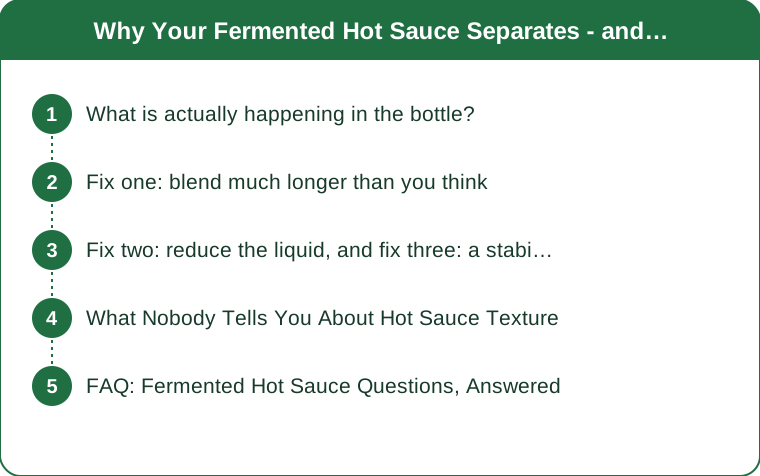
What is actually happening in the bottle?
A suspension slowly losing its argument with gravity.
Blended pepper is solid particles in liquid. Cell wall fragments, fibre, seed pieces, and pulp, suspended in water that came out of the peppers plus whatever brine you added. Those particles are denser than the surrounding liquid, so they settle. This is the same reason unfiltered juice separates and why a vinaigrette needs shaking.
Particle size determines the rate. Larger particles settle faster - the relationship is strong enough that halving particle size slows settling by roughly a factor of four. This is why blending duration matters far more than blending power, and why thirty seconds in a good blender is not the same as three minutes in the same blender.
Fermentation makes it worse, and that is worth understanding. The lactic acid bacteria break down pectin and cell wall structures during fermentation, which releases bound water and reduces the natural thickening that pectin provides in fresh peppers. A fermented sauce separates more readily than a fresh blended one made from the same peppers, which is why people who moved from quick sauces to fermented ones suddenly encounter this.
Acidity contributes too. The pH drops through fermentation, typically to somewhere between 3.2 and 3.8, and at low pH some of the proteins and pectins that would otherwise help hold structure lose their ability to do so.
And it is entirely a texture issue. Separation tells you nothing about safety. A properly fermented sauce at a pH below 4.0, kept refrigerated, is fine whether it separates or not.
Fix one: blend much longer than you think
The cheapest fix, and the one most people under-do by an order of magnitude.
Aim for three to five minutes of continuous high-speed blending. Not thirty seconds until it looks smooth - looking smooth and being smooth at the particle scale are very different things. A sauce blended for four minutes will hold together for weeks longer than the same sauce blended for forty seconds.
Heat is the side effect to manage. Long blending heats the sauce, which can affect the live cultures if you are keeping the sauce raw. If that matters to you, blend in two or three shorter bursts with rest periods, or chill the ingredients first.
Straining after blending changes the result substantially. Push the blended sauce through a fine mesh sieve and discard the coarse solids - typically skins and seed fragments, which are the largest and fastest-settling particles. You lose perhaps 10 to 15 per cent of the volume and gain considerably better stability and a noticeably smoother texture.
A blender with a tamper genuinely helps because thick sauce forms a cavity around the blades and stops circulating, at which point you are blending air. If your blender does not have one, stop and scrape down every 45 seconds.
Realistic expectation: long blending plus straining gets you to a sauce that holds for two to four weeks in the fridge before visible separation. It does not get you to commercial stability, and nothing except a stabiliser will.

Fix two: reduce the liquid, and fix three: a stabiliser
Reducing the liquid
If your sauce has too much free water, remove some of it. Strain the blended sauce through a fine sieve or cheesecloth, collect the liquid separately, simmer it down by a third to a half, then blend it back into the pulp.
This concentrates flavour at the same time, which is a genuine bonus - reduced fermentation brine has a depth that the unreduced version does not. The cost is that heating kills the live cultures, so this is a choice between a raw sauce and a stable one.
A lower-effort version: simply use less brine at the blending stage. Many recipes call for adding all the fermentation liquid back, and using two-thirds of it produces a thicker sauce that separates much less.
Xanthan gum, the actual commercial answer
Every commercial hot sauce that does not separate contains a stabiliser, and it is usually xanthan gum. It is a fermentation product itself, it is flavourless, and a very small quantity does the whole job.
The dose is 0.1 to 0.3 per cent by weight - for 500g of sauce, that is 0.5g to 1.5g. Start at 0.2 per cent. Overdosing is the classic mistake and produces a slimy, slightly gelatinous texture that is immediately recognisable and cannot be undone. Weigh it; do not measure by spoon.
Technique matters. Xanthan clumps instantly if dumped into liquid. Either sprinkle it slowly into a running blender through the lid opening, or pre-mix it with a small amount of oil or sugar before adding. Blend for a further 60 seconds after adding, then rest the sauce for a few hours - it hydrates fully over time and the final thickness is not apparent immediately.
Alternatives: a small amount of blended cooked carrot, onion, or apple adds pectin and body naturally, which is why so many classic hot sauce recipes include a carrot that nobody questions. Guar gum works similarly to xanthan but is fussier at low pH.
What Nobody Tells You About Hot Sauce Texture
Commercial sauces set your expectations dishonestly. Every bottle on the shelf contains a stabiliser, has been homogenised at pressures a home blender cannot approach, and often has been heat treated. Comparing your raw fermented sauce to that is comparing two different products.
Shaking is a completely legitimate answer. Some of the best hot sauces in the world say “shake well” on the label. If separation only bothers you aesthetically, the fix costs two seconds and no ingredients. The pressure to produce a perfectly stable sauce at home is largely self-imposed.
Separation actually indicates a healthy ferment in one specific way. The pectin breakdown that causes it is a consequence of active bacterial fermentation. A sauce that does not separate at all, from a raw ferment with no stabiliser, may not have fermented very much.
The layer on top is not mould and the two look nothing alike. Separated liquid is clear-ish, coloured, and continuous. Mould is fuzzy, sits on the surface as distinct colonies, and is usually white, green, or black. Kahm yeast - a white, wrinkly film - is harmless but affects flavour and should be skimmed. If you are unsure, that is a reason to look closely rather than to guess.
Bottle shape changes how visible it is. A tall narrow bottle makes a small volume of separated liquid look like a dramatic layer. The same sauce in a wide jar looks fine. This is worth knowing before you reformulate a recipe that was never actually a problem.
And pH is the thing to actually check. Get pH strips or a meter. Below 4.0 is the safety threshold for a fermented sauce, and knowing your number turns a lot of anxious guessing into a two-second check. If a ferment smells genuinely wrong, has visible fuzzy mould, or you cannot verify pH, discard it. This is general information, not food safety certification.
FAQ: Fermented Hot Sauce Questions, Answered
Why does my fermented hot sauce separate?
Because it is a suspension of solid pepper particles in liquid, and those particles are denser than the liquid, so gravity pulls them down over days. Fermentation makes it more likely by breaking down the pectin that would otherwise provide some natural thickening.
Is separated hot sauce safe to eat?
Separation says nothing about safety - it is purely a physical texture issue. What matters for safety is pH below 4.0, refrigeration after fermentation, and the absence of fuzzy mould. A separated sauce that meets those conditions is fine.
How much xanthan gum should I use in hot sauce?
Start at 0.2 per cent by weight - about 1g per 500g of sauce - and weigh it rather than measuring by spoon. Too much produces a slimy texture that cannot be fixed. Add it slowly into a running blender and let the sauce rest a few hours before judging the thickness.
How do I make hot sauce thicker without additives?
Blend for three to five minutes rather than thirty seconds, strain out the coarse solids, use less of the fermentation brine, and include a cooked carrot, onion, or apple in the blend for natural pectin. Reducing the strained liquid before recombining also works, at the cost of the live cultures.
TL;DR:
- Separation is gravity acting on suspended particles, not spoilage.
- Fermented sauces separate more than fresh ones because fermentation breaks down pectin.
- Blend for three to five minutes and strain - the biggest free improvement available.
- Xanthan gum at 0.2 per cent by weight is the actual commercial answer. Weigh it.
- Shaking the bottle is a completely respectable solution and always has been.
Every bottle on the shop shelf is hiding a stabiliser and a homogeniser. Yours is just being honest about what blended peppers do.
Keep Reading
This article is for general informational purposes only and is not medical advice. Always consult a qualified health professional for guidance specific to you.