Why Your Ferment Changes Completely When You Move It Off the Counter
Quick Answer: Temperature drives fermentation speed more than any other variable, and a few degrees changes which microbes dominate - not just how fast they work. A counter next to an oven can run 6 to 8 degrees warmer than a shelf across the room, which is the difference between a fast, sharp, sometimes mushy kraut and a slow, complex, crisp one. Light exposure and airflow matter too. Pick a spot in the 18 to 22C range, keep it out of direct sun, and leave it there for the whole batch.
You did not change the recipe. You changed the microclimate, and in fermentation the microclimate is the recipe.
Here is what actually differs between two spots in the same kitchen.

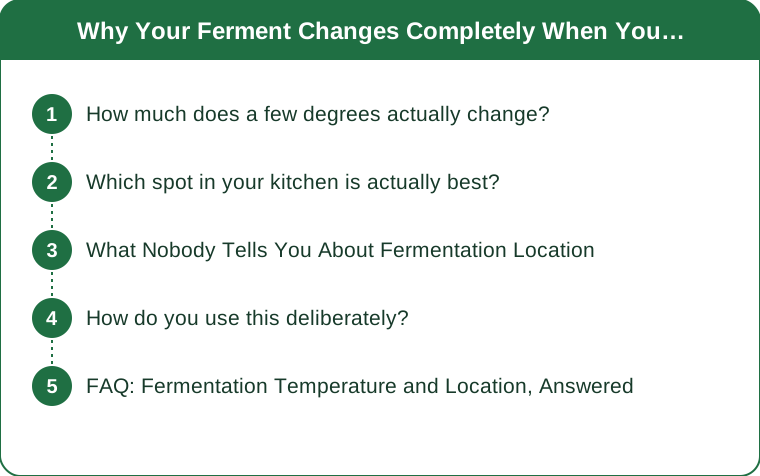
How much does a few degrees actually change?
Fermentation rate roughly doubles for each 10C increase, within a workable range. That is a general rule for biological reaction rates, and it means a ferment at 24C finishes dramatically faster than one at 18C - not slightly faster.
Different temperatures favour different bacteria. Vegetable ferments run through a succession of species, and warmer conditions push through the early stages faster and can favour species that produce softer texture and a sharper, less complex flavour.
Cooler conditions produce better texture. Slow fermentation at 18 to 20C gives firmer, crisper vegetables, because pectin-degrading enzyme activity has less time and less favourable conditions to work.
Flavour complexity develops with time, not speed. A three-week kraut at 18C and a five-day kraut at 26C are genuinely different products, and the slow one has more going on regardless of preference.
Warm spots also raise the risk of surface yeast. Kahm yeast, the wrinkled white film that is harmless but unpleasant tasting, is much more common in warm, slow-brine conditions.
And a counter next to an oven or a sunlit window can be 6 to 8 degrees above the room. This is the actual mechanism behind most inconsistent home ferments, and it is entirely invisible unless you put a thermometer there.
Which spot in your kitchen is actually best?
Aim for 18 to 22C for vegetable ferments. This range is a reasonable compromise between speed and quality for kraut, kimchi, and pickles, and it is achievable in most homes for most of the year.
Away from the oven, the fridge exhaust, and the radiator. All three create local hot zones. The side of a fridge in particular is warmer than the room in most kitchens and is a very common accidental ferment location.
Out of direct sunlight, always. Light degrades some compounds and heats the jar unevenly, and a jar in a sunbeam for two hours a day experiences a temperature cycle rather than a stable temperature.
A low cupboard or a pantry shelf is usually the best available option. Stable, dark, and typically a degree or two below room temperature, which is exactly what you want.
Kombucha wants it warmer, around 22 to 26C. It is the exception on this list, and putting kombucha in the cool cupboard that suits your kraut will produce a very slow, weak brew.
Put a cheap thermometer where the jar actually sits. Not on the wall, not in the room - beside the jar. People are consistently wrong about their own kitchen by several degrees, and this costs about the price of a coffee to resolve permanently.

What Nobody Tells You About Fermentation Location
The daily temperature swing matters as much as the average. A spot that hits 25C at 4pm and 17C at 5am has an average of 21C and behaves like neither. Stability beats a good average.
Late August is the worst time of year for this in most homes. Warm afternoons, cool nights, no heating on yet, and windows open irregularly produce the widest daily swings of the year - which is exactly why ferments started now behave unpredictably.
Moving a jar mid-ferment is worse than a mediocre spot. The microbial succession responds to conditions, and changing conditions in week two produces inconsistent results. Choose once, then leave it.
Jar size changes thermal behaviour. A small jar tracks room temperature closely; a large crock has thermal mass and lags behind, which makes it more forgiving of a swinging environment.
Airflow affects surface activity, not the ferment itself. A jar in a draught develops surface film more readily because the top is disturbed and dries slightly. A still, dark corner is genuinely better.
And when the heating comes on, everything changes again. The spot that was perfect in September becomes a warm spot in November if it is anywhere near a radiator. Re-check with the thermometer once the heating starts.
How do you use this deliberately?
Choose the temperature to suit the result you want. Cooler and slower for crisp texture and complexity; warmer and faster when you want a batch finished in under a week and do not mind a sharper, softer result.
Use the seasonal shift rather than fighting it. As the house cools through September and October, ferments naturally slow and improve in texture. This is the best fermentation season of the year in most homes and it is worth taking advantage of.
Start a batch and a control in two spots. Same recipe, two locations, taste both. One experiment teaches you more about your own kitchen than any amount of reading.
Adjust salt with temperature. Slightly higher salt slows fermentation and adds a safety margin in warm conditions; standard salt levels are fine in a cool, stable spot.
Taste on a schedule rather than at a deadline. A recipe that says seven days assumes a temperature. Taste from day four in a warm spot and from day ten in a cool one.
And refrigerate to stop it when it tastes right. Cold does not stop fermentation entirely but slows it dramatically, which is what preserves the version you liked instead of the version it becomes three days later.
FAQ: Fermentation Temperature and Location, Answered
What is the best temperature for fermenting vegetables?
Around 18 to 22C for kraut, kimchi, and pickles - a compromise between reasonable speed and good texture. Kombucha is the exception and prefers roughly 22 to 26C.
Why is my ferment so much faster than the recipe says?
Almost always temperature. Reaction rates roughly double for each 10C increase, so a spot near an oven or a sunlit window finishes a batch in a fraction of the stated time.
Can I move a ferment while it is working?
Better not to. Microbial succession responds to conditions, and changing them mid-batch produces inconsistent results. Choose the spot before you start and leave it there.
Why does my kraut go soft?
Warm fermentation is the most common cause - pectin-degrading activity is favoured by higher temperatures. A cooler, slower ferment produces noticeably firmer vegetables.
Where is the worst place to ferment in a kitchen?
Beside the oven, next to the fridge exhaust, or anywhere that gets direct sun for part of the day. All three create local hot zones several degrees above the room.
TL;DR:
- Temperature is the dominant variable: rates roughly double per 10C, and warmer conditions change which microbes dominate, not just the speed.
- Aim for 18 to 22C for vegetables and 22 to 26C for kombucha; a low cupboard or pantry shelf is usually the best spot in a home.
- Avoid oven-adjacent counters, the side of a fridge, and direct sun - all can run 6 to 8 degrees above the room.
- Daily swing matters as much as the average, and late August has the widest swings of the year.
- Choose the spot once and leave it, put a cheap thermometer beside the jar, and taste on a schedule rather than at a deadline.
Keep Reading
This article is for general informational purposes only and is not medical advice. Always consult a qualified health professional for guidance specific to you.