How to Tell If a Stalled Ferment Can Be Rescued or Should Be Binned
Quick Answer: A stall is usually temperature, salt or a dead starting culture — not spoilage. The decision comes down to three checks: does it smell sour and clean, is the pH below 4.6, and is the surface free of fuzzy growth? Pass all three and it is almost certainly rescuable. Fail the smell or the fuzz test and it goes in the bin, no matter how much you want to save it.
The jar stopped bubbling on day three and has done nothing since. It has been sitting there for a week and you have no idea whether you are looking at a slow ferment or a failed one.
There are only about five reasons a ferment stalls, and they are distinguishable in a couple of minutes.

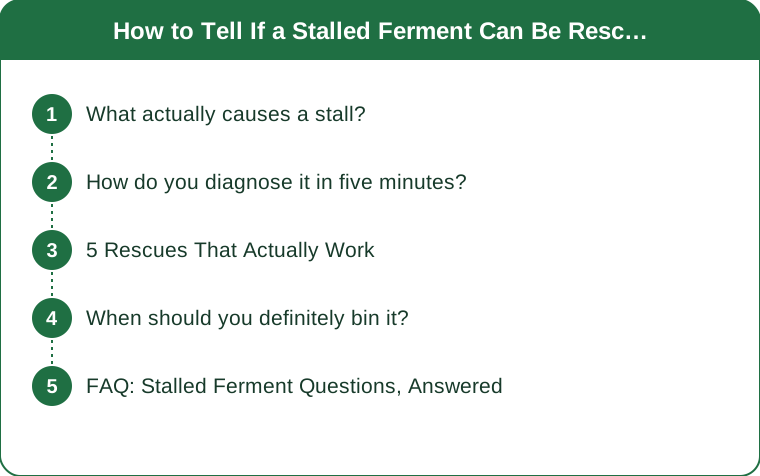
What actually causes a stall?
Five candidates, in rough order of how often they are the answer.
Temperature is by far the most common. Lactic acid bacteria work best between roughly 18 and 22°C. Below about 15°C activity slows dramatically and can appear to stop entirely; below 10°C most ferments effectively pause. If your kitchen has cooled over the last few weeks — and in most homes it has — a jar in the same spot as last month is now several degrees cooler.
Salt concentration too high. Above roughly 5 percent salt by weight, most lactic acid bacteria are substantially inhibited. This happens when people estimate rather than weigh, or when brine is topped up with more salted water. The usual working range is 2 to 3 percent for vegetables.
Nothing to eat. Fermentation of low-sugar vegetables can genuinely finish early. A stall at day ten with a properly sour smell and a low pH is not a stall at all — it is a completed ferment.
The starting population was too small. Heavily washed or peeled produce, or vegetables that have been refrigerated for a long time, carry fewer wild lactobacilli. Cold-stored supermarket cabbage ferments more slowly than fresh market cabbage for exactly this reason.
Chlorinated water. Tap water with residual chlorine can suppress the culture, particularly in the early stages. Leaving water out overnight or using filtered water removes it.
And the one people forget: bubbling stops when carbon dioxide production slows, which happens naturally as acidity rises and the process completes. No bubbles is not the same as no fermentation. Judging by bubbles alone is the most common misdiagnosis.
How do you diagnose it in five minutes?
Three checks, in this order, and the order matters because the first one can end the process immediately.
1. Look at the surface. You are looking for anything fuzzy, raised, or coloured — black, green, pink, blue, or anything with visible texture. That is mould, and a mouldy ferment goes in the bin. Do not scrape and continue; mould in soft, wet substrates sends hyphae well below the visible growth.
A flat, white, wrinkled or powdery film is different. That is almost certainly kahm yeast — harmless, not mould, and skimmable. It indicates oxygen exposure and often a slightly low salt level. It can affect flavour if left, so skim it and press the vegetables back under the brine.
2. Smell it. A healthy ferment smells sour, clean, tangy, sometimes yeasty or briny. The words that mean stop are putrid, rotten, cheesy in a bad way, or like rubbish. Trust this instinct completely. Human noses evolved for exactly this decision and are extremely good at it.
3. Test the pH. This is the check that turns opinion into fact, and pH strips cost almost nothing. Below 4.6 is the food safety threshold — at that acidity, the pathogens people worry about cannot grow. A properly fermented vegetable typically finishes between 3.2 and 3.8.
If it is above 4.6 and has stopped, that is the genuinely ambiguous case: the ferment did not acidify enough to protect itself. If it also smells fine and looks fine, it can usually be restarted. If it has been sitting above 4.6 at room temperature for many days, bin it.
A note on taste: tasting is a reasonable final check on something that passed all three above. It is not a substitute for them, and it is never the first step.

5 Rescues That Actually Work
1. Move it somewhere warmer. The single highest-success fix, and the first thing to try. A spot near a kitchen appliance, on top of the fridge, or in an oven with only the light on will typically bring a jar from 15°C to a working temperature. Give it 48 hours before judging. A large proportion of autumn stalls resolve entirely with this and nothing else.
2. Dilute an over-salted brine. If you suspect too much salt, pour off some brine and replace with unsalted, unchlorinated water. Do this in modest steps — around 20 percent of the volume at a time — and give it two days. Overcorrecting into low-salt territory creates a soft, slimy ferment, which is a different failure.
3. Add a live starter. A tablespoon or two of brine from an active ferment, or from a live unpasteurised sauerkraut, introduces a working population. This is the most reliable fix for a jar that never got going in the first place, and it works far better than waiting.
4. Fix the submersion. Anything above the brine line is exposed to oxygen and is where kahm yeast and mould start. Press everything down, add a weight, and top up with brine at the same salt concentration as the original. A great many stalls are actually surface problems.
5. Accept that it is finished. If the pH is 3.5, the smell is good, and it tastes right, the ferment has not stalled. Put it in the fridge and eat it. This is the most common correct answer for a jar that stopped bubbling around day seven to ten.
When should you definitely bin it?
The list is short and none of the items are negotiable.
Any fuzzy or raised growth. Black, green, pink, orange, blue, white-and-fuzzy — mould, bin it. The exception is only the flat, wrinkled white film of kahm yeast, and if you are unsure which you are looking at, err towards binning. Fuzz is the distinguishing feature: mould has height and texture, kahm yeast lies flat.
Any putrid, rotten or genuinely off smell. Not sour, not funky, not sulphurous-in-a-cabbage-way — actually foul. Bin it.
Slimy, ropey brine with an off smell. Slight sliminess early can be normal, especially in high-sugar vegetables, and often clears. Persistent ropiness combined with a bad smell does not.
pH above 4.6 after many days at room temperature. The ferment failed to protect itself and has been sitting in the risk zone. This is the one case where things can be wrong without looking or smelling wrong, which is exactly why the pH strips are worth owning.
Anything you are genuinely unsure about. A jar of cabbage costs a couple of dollars. This is not the place to be economical.
And a note on the season: the swing between warm afternoons and cool nights right now is the hardest condition of the year for consistent fermentation. A jar that sits at 22°C at 3pm and 14°C at 6am is being repeatedly started and stopped, which produces exactly the confusing half-fermented results people ask about in early autumn. A more stable spot — an interior cupboard rather than a counter near a window — solves more problems than any technique change.
This is general information, not medical advice. If you have any doubt about the safety of home-fermented food, do not eat it.
FAQ: Stalled Ferment Questions, Answered
How long should I wait before calling it stalled?
At cool temperatures, give it a full week before worrying. Visible activity in the first 24 to 72 hours is typical at room temperature, and considerably slower below 18°C. Patience resolves more cases than intervention.
Do I really need pH strips?
They cost a few dollars and they turn the ambiguous cases into clear ones. If you ferment more than occasionally, yes. Narrow-range strips covering 2.5 to 5.0 are more useful than universal ones.
Can I restart a ferment that has been in the fridge?
Yes. Bring it back to room temperature and it will usually resume, more slowly than the first time. Refrigeration pauses fermentation rather than ending it.
Why does it smell sulphurous?
Brassicas — cabbage, cauliflower, broccoli — release sulphur compounds during fermentation, and it is normal and often strong in the first few days. It usually mellows. Sulphurous is not the same as putrid.
My ferment went soft. Can that be fixed?
No, texture loss is permanent. It is caused by too-low salt, too-warm fermentation, or pectin-degrading enzymes. It is generally safe to eat if everything else checks out; it is just unpleasant. Tannins — a grape leaf, a black tea bag — help prevent it next time.
Is a stalled ferment more likely as the weather cools?
Yes, substantially, and it is the most common cause of autumn fermenting problems. The recipe did not change; the kitchen did.
TL;DR:
- Bubbles stopping is not the same as fermentation stopping. Most stalls are temperature.
- Three checks: fuzzy growth on the surface, the smell, and a pH below 4.6.
- Flat white film is kahm yeast and skimmable. Anything with height or colour is mould — bin it.
- Rescues that work: move it warmer, dilute over-salted brine, add live starter brine, fix submersion.
- Above 4.6 for days at room temperature is a bin, regardless of how it looks.
Most of the jars people are about to throw away are simply cold. Move it somewhere warm, wait two days, and check again before deciding.
Keep Reading
This article is for general informational purposes only and is not medical advice. Always consult a qualified health professional for guidance specific to you.