Fermenting When Your Kitchen Swings Between Warm Days and Cold Nights
Quick Answer: Fermentation rate roughly doubles for every 10 degrees Celsius of temperature increase, so a kitchen that swings from 16C at night to 24C in the afternoon is running two very different ferments in one jar. The result is uneven texture, unpredictable timing and occasional off flavours. The fix is not temperature control so much as location choice - an interior cupboard or a lower shelf holds a far steadier temperature than a counter near a window, and steadiness matters more than the exact number.
The same recipe that worked all summer suddenly takes twice as long, or goes too fast and turns soft.
Nothing changed except the weather outside.
Autumn kitchens swing, and ferments notice.

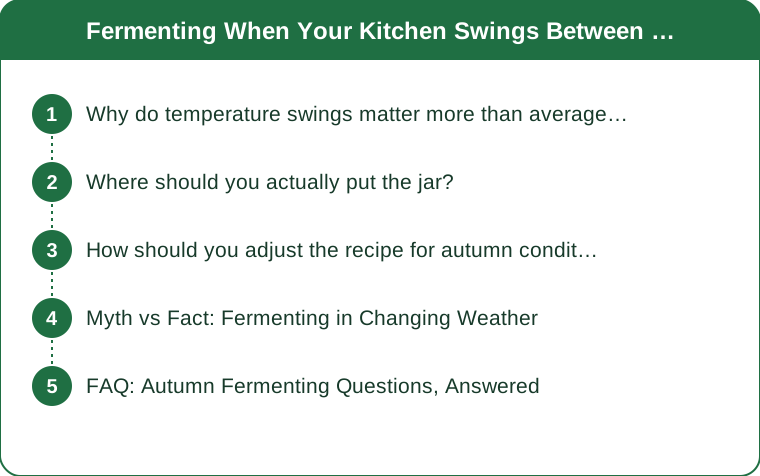
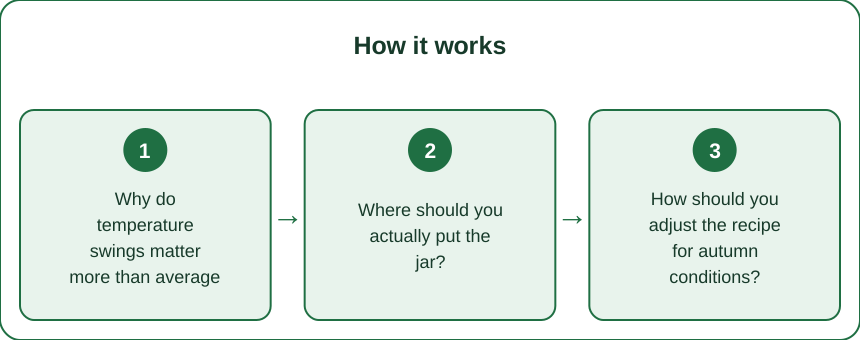
Why do temperature swings matter more than average temperature?
Because microbial activity responds to temperature non-linearly, and different organisms respond differently.
Fermentation rate is strongly temperature dependent. As a rough guide, microbial activity approximately doubles for every 10C increase within the workable range. So an afternoon at 24C is doing roughly twice the work of a night at 16C.
But the more important effect is which organisms are favoured. Vegetable fermentation runs through a succession of bacterial species, and they have different temperature preferences. Warmer conditions favour some, cooler conditions favour others. A swinging temperature keeps handing the advantage back and forth, which produces a different flavour profile from a steady ferment at the average of the two.
This is why average temperature is misleading. A steady 20C and a swing between 16C and 24C average the same and do not produce the same result.
What the swing actually causes:
- Uneven texture, with faster softening during warm periods
- Unpredictable timing, since your usual day count no longer maps to a stage
- Flavour that varies batch to batch in a way that is hard to trace
- Occasionally, off flavours, when warm periods let less desirable organisms get a foothold
And there is a physical effect too: warm periods produce more gas and more brine expansion, cool periods contract. The repeated cycle pushes brine out of loosely sealed jars and can pull air back in, which is the mechanism behind a lot of autumn surface mould.
Where should you actually put the jar?
Somewhere boring, interior, and low - and the specific location matters more than any equipment.
The counter next to a window is the worst common choice. It gets direct heat gain during the day and radiative loss at night, producing the widest swing in the house.
Better options, in rough order:
- An interior cupboard away from external walls. Usually the steadiest place in a kitchen and it costs nothing
- A lower shelf or floor-level cupboard, since warm air stratifies upward and floors are steadier
- A basement or cellar where available - the classic choice for good reason
- An interior hallway cupboard, which is often steadier than anywhere in the kitchen itself
Places to avoid: above or beside the oven, on top of the fridge - which vents warm air - near a radiator that comes on in the evening, and anywhere in direct sun.
The radiator point deserves emphasis in autumn specifically. Heating systems turning on for the first time creates a new evening warm period that was not there in September, and it catches a lot of people out. The ferment that was fine in early October behaves differently the week the heating starts.
A cheap min/max thermometer next to the jar for one week is genuinely worth doing. Most people are surprised by the range, and the reading tells you whether to change location or change the recipe.
On equipment: a temperature-controlled chamber is excellent and unnecessary for most home fermenting. Choosing the right cupboard captures most of the available benefit.

How should you adjust the recipe for autumn conditions?
Salt and timing are the two levers, and salt is the more useful one.
Salt concentration slows fermentation and selects for salt-tolerant organisms, which is a useful counterweight when warm periods would otherwise accelerate things.
A practical approach:
- In a warm swinging kitchen, go toward the higher end of the recipe’s salt range, which slows the warm periods more than it slows the cool ones
- In a consistently cool autumn kitchen, the lower end of the range keeps fermentation moving
- Never below the recipe’s stated minimum, since salt is doing a safety job as well as a flavour one
Stop counting days and start tasting. This is the single most useful change for autumn. Day counts in recipes assume a steady temperature that your kitchen no longer has. Taste from day three and go by flavour and texture.
What to look for:
- Sourness developing steadily rather than suddenly
- Texture staying firm. Rapid softening means it is running too warm
- Steady bubbling rather than a violent phase followed by nothing
Refrigerate earlier than you would in summer if the kitchen is swinging. Moving to cold storage at a slightly under-fermented stage is far better than overshooting, since flavour continues to develop slowly in the fridge.
For anything sensitive to temperature - kombucha, yoghurt, sourdough starter - autumn is when a heat mat or a proofing box actually earns its place. Vegetable ferments are much more forgiving and rarely need it.
Myth vs Fact: Fermenting in Changing Weather
Myth: Cooler weather means fermentation stops. Fact: It slows substantially and continues. Most vegetable ferments work fine down to around 15C - they simply take longer, and the slower version often tastes better.
Myth: The average temperature is what matters. Fact: A steady 20C and a swing between 16C and 24C average the same and produce different results, because different organisms are favoured at each end of the swing.
Myth: If it is bubbling, it is fine. Fact: Bubbling indicates activity, not correct activity. Rapid bubbling with rapid softening is a sign of running too warm, and it usually precedes a mushy result.
Myth: You need equipment to control temperature. Fact: Choosing an interior cupboard instead of a counter captures most of the available stability for free. Equipment matters for kombucha, yoghurt and sourdough far more than for vegetables.
Myth: Slower fermentation is worse. Fact: Cooler, slower ferments frequently produce better texture and more complex flavour. Traditional practice in many cultures deliberately used cool cellars for exactly this reason.
Myth: A day count from a recipe is reliable. Fact: Day counts assume a temperature the recipe rarely states. In a swinging autumn kitchen, taste is the only reliable guide and the difference can easily be double or half the stated time.
FAQ: Autumn Fermenting Questions, Answered
Why is my kraut taking twice as long this month?
Cooler temperatures slow microbial activity substantially - roughly halving the rate for each 10C drop. It is not a problem, and the slower version often has better texture. Taste rather than counting days.
Can I move a jar mid-ferment?
Yes, and moving it to a steadier location is usually an improvement at any stage. Avoid moving it somewhere much warmer, which can cause a sudden burst of activity and overflow.
Should I use more salt in autumn?
If your kitchen swings warm in the afternoons, the higher end of the recipe range helps moderate the fast periods. In a consistently cool kitchen the lower end keeps things moving. Never go below the stated minimum.
What does the heating coming on do to my ferments?
It adds an evening warm period that was not there before, which changes the swing pattern noticeably. Ferments that were behaving predictably in early autumn often speed up the week the heating starts - worth relocating away from radiators.
Is white film on top a problem?
A thin white film is usually kahm yeast - harmless, and it can affect flavour if left. Fuzzy growth in colours is mould, and that batch should be discarded. Temperature swings that pull air into the jar make both more likely.
Should I refrigerate earlier than in summer?
If the kitchen is swinging, yes. Moving it to cold storage slightly under-fermented is safer than overshooting, and the flavour continues developing slowly in the fridge.
TL;DR:
- Fermentation rate roughly doubles per 10C, so a daily swing runs two different ferments in one jar
- Different organisms are favoured at each end of the swing, which is why average temperature misleads
- Location beats equipment - an interior lower cupboard is far steadier than a counter by a window
- The week the heating comes on changes the pattern; move jars away from radiators
- Adjust salt toward the higher end of the range in warm swinging kitchens
- Stop counting days and start tasting from day three
- Refrigerate slightly early rather than overshooting
Steadiness matters more than the number. Pick a boring cupboard and most autumn ferment problems disappear.
Keep Reading
This article is for general informational purposes only and is not medical advice. Always consult a qualified health professional for guidance specific to you.