Fermenting in a Hot Kitchen: Why August Batches Race Ahead (and How to Slow Them Down)
Quick Answer: Fermentation speed roughly doubles with every 10-degree rise, so an 85F kitchen runs a batch two to three times faster than the 65-70F sweet spot - and speed is not free. Heat favors fast-souring bacteria over the slower flavor-builders, softens vegetables, and invites kahm yeast. The fixes: find your home’s coolest zone, use a water bath or cooler box as a thermal buffer, bump salt slightly toward 2.5 percent, ferment in smaller jars, check daily instead of weekly, and move batches to the fridge earlier than feels right. Or lean in - some ferments genuinely love the heat.
The jar that bubbled politely all spring is now hissing like a science-fair volcano by day two, and the kraut tastes sharp before the week is out. Nothing is wrong with your technique. Your kitchen changed climates, and the microbes noticed before you did.
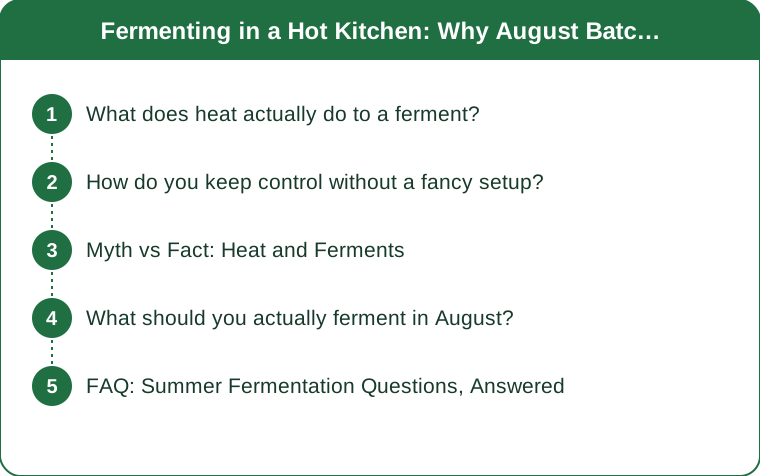
What does heat actually do to a ferment?
It reshuffles who is working and how fast - and the who matters more than the fast.
Speed doubles fast. Microbial activity roughly doubles per 10 degrees F of warming within the relevant range. A kraut that needs three weeks at 65F can reach the same acidity in under a week at 85F. The bubbles, the pressure, the brine climb - everything you monitor happens on fast-forward, which is why summer jars overflow on counters that never saw a spill all spring.
The bacterial relay race gets scrambled. Classic vegetable ferments are a succession: early gas-producing bacteria acidify gently and build complex flavor compounds, then hand off to acid-tolerant workhorses that finish the souring. That early stage is where much of the depth comes from - and it is temperature-sensitive. In real heat, the succession compresses or skips: the fast finishers dominate early, and you get plenty of sour with less of the aromatic complexity. Technically fermented; noticeably flatter - the one-note sharpness of a rushed summer kraut.
Texture pays the tax. Heat accelerates the enzymes that break down pectin, the glue holding vegetable cell walls crisp. Warm-fermented cucumbers go soft at speed - which is why old picklers get obsessive about tannin-rich additions like grape or oak leaves in summer - and kraut loses its snap sooner.
Surface trouble moves in faster. Kahm yeast - the wrinkled white film that is harmless but musty-tasting - loves warm, low-acid early conditions and shows up in days rather than weeks. Actual molds get their window too if anything floats above the brine. The margin for a sloppy submersion job shrinks with every degree.
None of this makes summer fermenting a mistake. It makes it a different sport: shorter, faster, requiring daily attention instead of weekly - and with a few styles that genuinely play better in the heat.
How do you keep control without a fancy setup?
Six levers, all kitchen-grade.
1. Map your house for the cool spots. Basements run 10 to 15 degrees cooler than upstairs. Interior closets, the cabinet against a north wall, under the sink away from the dishwasher, near an AC vent - a five-dollar thermometer moved around for a day finds your fermentation zone. The counter that was perfect in April is often the worst spot in the house in August.
2. Use a water bath as a thermal flywheel. Stand jars in a basin or stockpot of water. Water’s thermal mass smooths out the afternoon spike that does the most damage, and evaporation off the sides sheds real heat - drape a damp towel over the jar shoulders with its edge in the water and you have built the classic off-grid cooler. This alone often buys back 5 to 8 degrees at the jar.
3. The cooler-box trick for genuine heat waves. A picnic cooler, jars inside, one frozen water bottle swapped morning and evening. Holds the low 70s through a 95-degree week with thirty seconds of daily effort. This is the summer answer for long ferments you refuse to reschedule.
4. Nudge salt up, within reason. Salt slows everything down and favors the bacteria you want over the ones you do not. If you kraut at 2 percent in winter, 2.5 percent is a sensible summer setting - slower, safer, crisper. Do not chase control past about 3 percent; you gain sluggishness and lose flavor balance.
5. Ferment smaller. Quart jars instead of the gallon crock: less thermal mass spiking in the afternoon, faster to chill when done, and a smaller loss if one batch runs weird. Summer is the season of many small jars.
6. Move the finish line earlier. Taste daily from day two or three - summer ferments blow past perfect in a day. The moment a batch tastes one notch shy of where you love it, into the fridge, where it creeps the rest of the way over a week and then holds. Cold is not the end of fermentation; it is the slow-motion setting - and in August it is your best friend.
Myth vs Fact: Heat and Ferments
Myth: A hot-weather ferment is a ruined ferment. Fact: It is a fast ferment with a compressed flavor arc - different, not spoiled. Salt, submersion, and acidity still do the safety work at 85F exactly as at 65F. The quality gap is real but manageable, and several styles - quick kimchis, hot sauce mashes, summer quick-pickled krauts - are traditionally made in exactly this weather.
Myth: The white film means throw it all away. Fact: Wrinkled, flat white film is almost always kahm yeast - harmless, if musty. Skim what you can, wipe the jar neck, make sure everything sits below the brine, and carry on; the batch underneath is usually fine. Fuzzy, raised, colored growth - green, black, pink - is mold, and that is the discard case. Flat-white-skim versus fuzzy-colored-toss is the entire triage.
Myth: More salt is always safer, so summer means lots more. Fact: Salt is a brake, not a force field, and past about 3 percent you mostly brake the good bacteria while the flavor goes harsh and the texture rubbery. The summer adjustment is a half-point nudge, not a doubling - the rest of the control comes from temperature and timing.
Myth: Refrigeration kills the culture. Fact: Cold slows the microbes to a crawl without killing them - a fridge ferment keeps developing, gently, for weeks. Summer’s smartest move is using the fridge as a finishing room: pull batches slightly early and let them coast to perfect at 38F.
Myth: Bubbling hard means it is going great. Fact: Vigorous bubbling means fast CO2 production - activity, not quality. In summer it mostly means check the airlock, burp the jar, and put a plate under it. The best flavor development is quiet and slow; the loudest jars are just the warmest ones.
What should you actually ferment in August?
Match the project to the weather and the season’s produce - some ferments want this heat.
Lean in: hot sauce mash. Peppers are peaking at the market right now, and a pepper mash at 2.5 to 3 percent salt positively enjoys warm rooms - the fast, acid-forward profile suits hot sauce, and the batch is blended and bottled anyway, so texture loss is irrelevant. Late August is objectively hot sauce season: the raw material and the room temperature both cooperate.
Lean in: fast kimchi-style batches. Quick summer kimchis are traditionally made warm and eaten young - days, not months. Cucumbers, radish, chard stems, or early cabbage, fermented two to four days and straight to the fridge. The compressed timeline is the authentic version here, not a compromise.
Lean in: fruit quick-ferments. Tepache-style pineapple, fruit vinegars, and honey-fruit ferments run on warm-weather speed and are finished inside a week. High sugar plus heat means daily burping - and these are the jars that geyser if ignored, so shoulder-of-the-fridge them the moment they taste right.
Manage carefully: cucumbers and crisp krauts. Doable with the cool-spot, water-bath, smaller-jar toolkit - plus a tannin leaf for the cukes - but these are the projects that show heat damage first. Half-sour cucumbers on a four-day summer schedule beat full-sours attempted over three warm weeks.
Postpone: the long prestige projects. Misos, long krauts, anything meant to develop over months - September and October exist, and the cool months are their native climate. A fermentation calendar that matches projects to seasons beats fighting the thermometer twelve months a year.
And whatever you run this month: daily eyes-on. Thirty seconds a day - press everything under the brine, burp, sniff, taste from day two - is the entire summer discipline. Heat forgives nothing left floating, and rewards everything checked.
FAQ: Summer Fermentation Questions, Answered
Is it OK to ferment in hot weather?
Yes - salt, submersion, and acidity handle safety at summer temperatures just as they do in winter. What changes is speed and style: batches finish two to three times faster, flavors run sharper and simpler, and textures soften sooner. Check daily, refrigerate earlier, and favor short-timeline projects, and August ferments turn out well.
What temperature is too hot for fermentation?
The classic vegetable-ferment sweet spot is 65 to 72F. Up to about 80F you mostly trade some complexity for speed; sustained temperatures much above 85F push batches toward mushy textures, yeasty notes, and one-dimensional sourness. That is the range where cool spots, water baths, or the cooler-box-and-ice-bottle trick earn their keep.
Why did my summer sauerkraut turn soft?
Heat accelerates the pectin-degrading enzymes that break down cell walls, so warm batches lose crunch faster - especially if they also ran long. Fixes: ferment cooler, nudge salt toward 2.5 percent, use fresher firmer cabbage, run shorter timelines with an earlier move to the fridge, and add a tannin source like grape or oak leaf for cucumbers.
What is the white film on my ferment in summer?
A flat, wrinkled white layer is almost certainly kahm yeast - unsightly and musty but harmless. It thrives in warm early-stage ferments. Skim it, wipe the jar neck, re-submerge everything, and continue. Fuzzy or colored growth is mold and means discarding. Prevention: everything under the brine, adequate salt, cooler spot, faster timeline.
TL;DR:
- Heat doubles fermentation speed per 10 degrees - and trades flavor complexity and crunch for that speed.
- Control kit: coolest room, water bath with a damp towel, cooler-box with an ice bottle, salt nudged to 2.5 percent, small jars.
- Taste daily from day two; refrigerate one notch before perfect and let cold finish the job.
- Flat white film is skimmable kahm; fuzzy or colored is the discard case.
- Lean into what loves heat - pepper mash, fast kimchi, fruit ferments - and save the long projects for fall.
The microbes did not break the rules; the thermostat rewrote them. Work in the season you actually have, and August jars can be some of the year’s best.
Keep Reading
This article is for general informational purposes only and is not medical advice. Always consult a qualified health professional for guidance specific to you.