Your Ferments Are Slowing Down Because Your House Is
Quick Answer: Fermentation rate roughly halves for every 15–18°F drop in temperature, so a kitchen that has fallen from 78°F in August to 68°F in September ferments noticeably slower. Recipes almost always assume around 70°F, and your timeline needs adjusting rather than your recipe. Cooler ferments take longer and generally taste better — more complex, more sour without harshness, and crisper texture.
The kraut that was ready in five days all summer is now sitting on day eight tasting like salty cabbage.
Nothing is wrong with it. The room changed and the recipe did not.
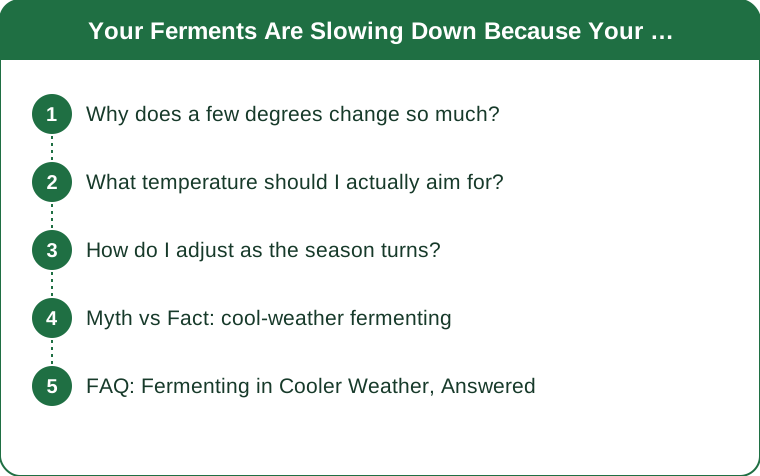
Why does a few degrees change so much?
Because fermentation is bacterial metabolism, and bacterial metabolism is strongly temperature-dependent.
The rough rule chemists use is that reaction rates roughly double for every 18°F increase in temperature. Applied to a fermentation crock: your kitchen dropping from 78°F to 68°F is not a small change — it is closer to halving the pace.
That is why a five-day summer kraut becomes an eight- or nine-day autumn kraut without anything else changing.
But the temperature also changes which bacteria dominate, and this is the part that matters for flavor. Vegetable fermentation runs through a succession of species: Leuconostoc species start things off and produce a lot of carbon dioxide and milder acids, then Lactobacillus species take over and drive the sourness.
Warmer ferments rush past the early stage and go straight to hard acidity. Cooler ferments let the early stage run longer, which produces more of the aromatic compounds that make a good kraut taste like something rather than just tasting sour.
This is why traditional kraut making is an autumn activity in a cold cellar rather than a summer activity in a hot kitchen. It was never nostalgia — cool fermentation genuinely tastes better.
What temperature should I actually aim for?
65–72°F is the sweet spot for most vegetable ferments. Reliable, reasonably paced, and good flavor development.
Below 60°F: very slow. Not harmful, and traditional cellar krauts fermented at 55°F for six weeks are superb, but you need patience and you need to check less often, not more.
Above 75°F: fast and increasingly risky. Fast is not the problem in itself; the problem is that soft texture and off-flavors are far more likely above 75°F, and the margin for error on salt concentration narrows considerably.
Above 80°F: genuinely difficult. This is where mushy kraut, yeasty flavors, and surface problems multiply.
By product:
Sauerkraut and kimchi: 65–72°F. Kimchi is often deliberately fermented cool and then refrigerated to develop slowly for weeks.
Pickles (cucumbers): 70–75°F, and they are the most texture-sensitive of the common ferments. Cucumbers go soft fast in warm conditions.
Kombucha: wants it warmer, 75–82°F. This is the one that slows down most obviously as the house cools, and the usual autumn complaint — my kombucha stopped working — is almost always temperature rather than a sick culture.
Yogurt: needs a controlled 108–112°F regardless of season, which is why it needs an appliance and the others do not.
Buy a cheap thermometer and put it next to the jars, not on the wall. Counters near windows and against exterior walls run several degrees cooler than the room average.
How do I adjust as the season turns?
Go by taste and by signs, not by the calendar. This is the whole answer, and everything below is in service of it.
Signs a vegetable ferment is progressing normally: bubbles within one to three days, brine going cloudy, a clean sour smell developing, and the vegetables changing from bright to muted in color.
Signs it is just slow, not stalled: bubbles present but sparse, mild sourness, everything else normal. Wait. Slow is fine.
Signs it has actually stalled: no bubbles at all after four days at 65°F or above, no change in smell, no cloudiness. Usual causes are too much salt, chlorinated water, or a temperature below 55°F.
Practical adjustments for a cooling house:
Move the jars. The top of the refrigerator, a high shelf, or a spot near — not on — a heat source gains you several degrees. Warm air stratifies, so a high shelf is genuinely warmer than a low counter.
Reduce salt slightly. If you have been at the higher end of the range through a hot summer to keep things safe, coming back to 2 to 2.5% for cool-weather ferments speeds them up and is entirely safe at that concentration.
Extend your first-taste day. If you tasted on day four all summer, taste on day seven now, and expect to keep pushing that back as autumn deepens.
For kombucha specifically: a seedling heat mat under the vessel, or simply moving it off a cold floor, resolves most autumn slowdowns.
Myth vs Fact: cool-weather fermenting
Myth: A slow ferment is more likely to spoil. Fact: the opposite is generally true for vegetables. Slower, cooler fermentation produces firmer texture and fewer off-flavors. Warm and fast is the riskier direction, not cool and slow.
Myth: If it is not bubbling, it failed. Fact: visible bubbling peaks early and fades. A ferment on day ten that is not bubbling but smells and tastes sour is working normally.
Myth: White film on top means it is ruined. Fact: a thin, flat, white film is usually kahm yeast — harmless, though it can dull flavor if left. Skim it. Fuzzy growth in any color, raised above the surface, is mold and that batch goes.
Myth: You can speed up a cold ferment by adding more starter or brine from a previous batch. Fact: it helps a little at the start, but temperature remains the rate limit. You cannot inoculate your way past a 58°F room.
Myth: Refrigerating stops fermentation. Fact: it slows it dramatically but does not stop it. Kimchi and kraut keep developing in the fridge over weeks, which is why a jar tastes different in November than it did in September.
FAQ: Fermenting in Cooler Weather, Answered
My summer recipe timeline is now way off. Should I change the recipe?
No. Change only the timing and taste more patiently. Salt percentage, vegetable prep, and technique all stay the same.
Can I ferment in an unheated garage or porch in autumn?
Yes, if it stays above about 55°F and does not swing wildly. Large daily temperature swings are harder on a ferment than a steady cool temperature.
How do I know when to move it to the fridge?
When it tastes the way you want it to. There is no other test worth using. Refrigeration slows further development and holds it roughly where you liked it.
Does cooler fermentation change how long it keeps?
A properly fermented and refrigerated vegetable ferment keeps for months either way. Cooler primary fermentation often yields better texture over that storage time, because it started firmer.
TL;DR: The room got cooler and every timeline in your recipe stretched.
- Rate roughly halves for every 18°F drop. A five-day summer kraut is an eight-day autumn kraut with nothing else changed.
- 65–72°F is the target for most vegetable ferments; kombucha wants 75–82°F and slows most visibly in autumn.
- Cooler ferments taste better — the early bacterial stage runs longer and produces more aroma, not just acid.
- Judge by taste and signs, never by the calendar. Sparse bubbles plus developing sourness is slow, not stalled.
- Move jars to a high shelf — warm air stratifies and a top shelf can be several degrees warmer than the counter.
Put a thermometer next to your jars this week. Whatever number it shows is the one your recipes should have been written for.
Keep Reading
This article is for general informational purposes only and is not medical advice. Always consult a qualified health professional for guidance specific to you.